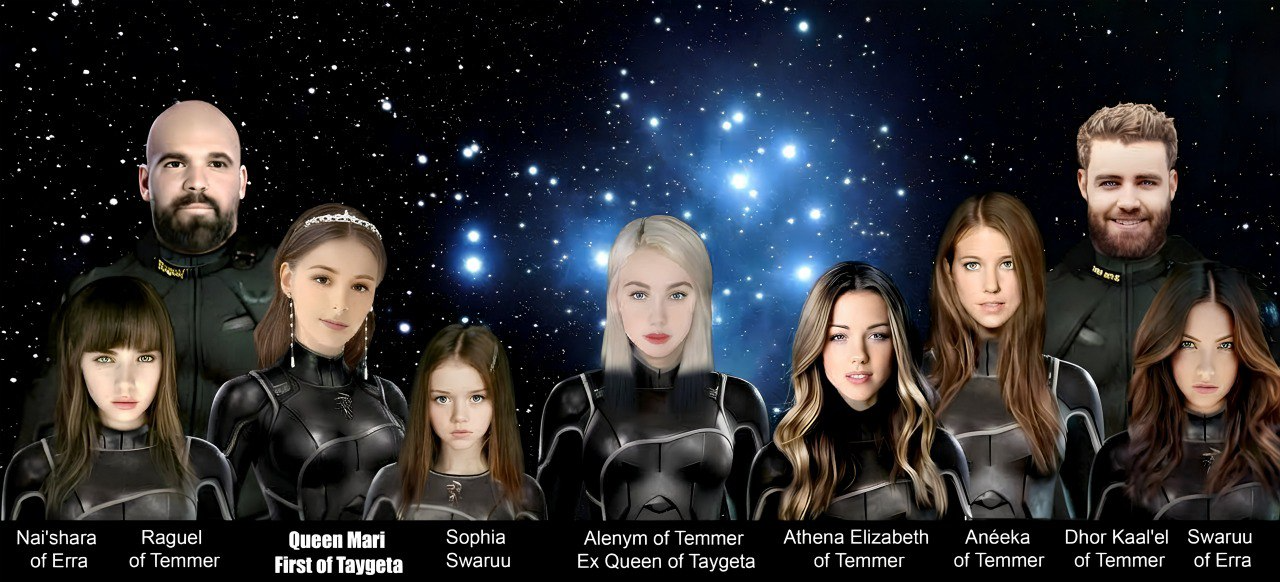

Interstellar Life 13 (Part 3) – Various Questions Related to Life in Space
THESE TRANSCRIPTS CAN BE ACCESSED TO MAKE TRANSLATIONS INTO ANY LANGUAGE (in text or video) ONLY WHEN THEY ARE ACCOMPANIED WITH THE OFFICIAL CREDIT TO THIS WEB PAGE AND OUR YOUTUBE CHANNELS WHERE THEY WERE FOUND.
Under no circumstances is it allowed to publish the information presented in our channels and on this page for commercial purposes (sale of books and promotional materials).
Author
Cosmic Agency, GosiaPublished
July 14, 2026Interstellar Life 13 (Part 3) – Various Questions Related to Life in Space
Originally in Spanish
Taygetan Ship attacked
Robert: Someone asked me: "How could they have attacked and damaged a spacecraft with conventional missiles if it was in stealth mode, existed in another density, and was protected by the energy toroid surrounding it?"
Anéeka: They fire a broad-spectrum directed-energy weapon pulse in a scalar form right as the missile reaches the ship. At that moment, the ship is not in another density because it is physically interacting with 3D. What it does, for a fraction of a second, is find the harmonic of the shields. Even so, it is very weak when they achieve this, so the damage is very minor. The annoying thing is that something—anything—actually penetrated the shields. But it's not a problem because we have now changed the shield dynamics to be scalar. Remember that scalar is a series of frequencies that are either transmitted or change multiple times—sometimes thousands of times—per second, affecting more than one density.
----------
Crashed ET craft
Robert: How is it possible that humans possess crashed or captured extraterrestrial spacecraft?
Anéeka: Other races have lower-technology ships than ours. Also, most of those captured ships were victims of new energy weapons that humans didn't have access to before. But they didn't crash; they were shot down. It is not feasible that a ship crossed half the Milky Way, between quasars, asteroid fields, and black holes, only to end up crashing in New Mexico. The Cabal doesn't have any Taygetean ships. Almost all captured ships belong to those we call Gardeners. They are the small grays.
----------
"Wifi" onboard
Robert: Someone asked me how the 'Wi-Fi' on your spacecraft works. I know it isn't actually Wi-Fi, but could you explain it using similar terminology?
Anéeka: Okay, no, in fact it isn't. It works like this: The human digital computers we have, whether original or replicated like this one, connect via Ethernet cable to a box about the size of a terrestrial voltage regulator that we have under the tables. The electrical power also connects there.
This box, of Taygetan construction, translates the wireless, over-the-air Zero-Point energy of the ship (a principle you call Tesla) into 100V alternating current electricity for the computer and other terrestrial devices. These little wireless devices, in the rooms of anyone with a digital computer, also transfer the digital information to a large modem in the CIC room "Combat Information Center" which connects via digital internet to a group of three satellites.
By the way, Toleka is directly above you right now. I am only 425 km away from you.
Robert: I can't see anything; the sky is completely covered. Thank you.
Anéeka: It connects via satellite internet-type systems to a group of satellites that the Federation has assigned to us. This then passes to the servers on Earth through normal means.
The signal can also be transferred to muons which then reach the station in Viera, which then passes it to the Federation servers on Earth and to the rest of the Internet.
Robert: Does each race have its own assigned satellites?
Anéeka: No, they share the same ones.
Robert: So, it goes from Toleka to Viera, and then directly to the Federation's servers on Earth? Okay. It´s not actually going directly from Toleka to the Federation's servers on Earth? By the Federation's servers on Earth, I mean its satellites.
Anéeka: Yes, but it amounts to the same thing; they are both systems. Because the Federation's servers on Earth belong to the Federation and are the ones that control the satellites and all of our internet traffic. Yes, they are Federation satellites on Earth.
Robert: Before the signal is converted into digital form, what is the process? That part wasn't clear to me. In what form does your signal leave the craft? What is it? Muons?
Anéeka: There are Federation converters on Earth and on Viera. Muons, data transmission via Lepton Muon, particles that modify or create a codifiable disturbance in a gravitational field in the ether.
Robert: Okay. That would be your version of the "Internet." And the signal is converted into digital form so that it doesn't overload the servers.
Anéeka: Yes.
Robert: Is it complicated to transform the signal?
Anéeka: Yes.
Robert: Why?
Anéeka: The systems are incompatible. Holographic systems are very high-energy; they burn out low-energy digital ones.
----------
The satellites orbiting Earth and space debris
Anéeka: Yes, that is why we need the shields on all the time, even if it looks dramatic, since those satellite pieces and debris are not that close together, but it is always a danger. However, our shields handle it without any problem.
A ship like this one has several layers of energy shields on the outside, like an onion, generated by the engines. These shields protect the ship from anything unwanted that approaches. Behind the shields, the hull has a thickness of up to 90 centimeters of polymorphous titanium, and in some critical areas, the hull thickness goes up to 2 meters.
Dhor Káal´el: Regarding the fighter craft, they are surrounded by an energy toroid that functions as a high-energy protective shield. This shield repels anything with an energy level lower than its own, since everything is fundamentally frequency and energy. The craft is also equipped with sonic weapons that generate an immense explosion of compressed sound around the craft's perimeter, whether it is stationary on the ground or flying within the atmosphere. This blast can destroy everything within a radius ranging from a few meters to approximately two to three kilometers.
In addition, the craft has a karmic defense system—an extremely advanced technology that reverses the incoming vector, meaning the direction from which any threat or projectile approaches. Whether the attack consists of a physical object, such as a bullet or missile, or an energy-based weapon, such as plasma or directed energy, the system redirects it back toward whatever launched it.
----------
Toleka's weaponry
Yazhi: Weapons, what they have are plasma naval cannons. Just one plasma naval cannon like the ones the Toleka has in turrets, when fired against a base on the surface of the Earth or anywhere else, the plasma energy beam or ray penetrates several meters, sometimes between 50 and 100m beneath the crust. And then it concentrates right there upon hitting a rock stratum that offers more resistance. Then, the accumulated energy expands in fractions of a second—and it is a lot—and explodes outward, lifting the target, the base, or whatever is on the surface, completely annihilating the structures, the buildings, and everything there, sending it flying up to thousands of meters into the air, amidst rock, earth, and debris, leaving a huge crater, and it's not nuclear, it's an energy weapon.
----------
Ships and tyres
Robert: Just like Mari talks about the drones, it would be great if she could tell us a little bit about the tires on the ship Hungry Gunabul, maybe? Because some people didn't understand it. They think that instead of tires, it uses lasers or whatever. They ask why tires and not, for example, antigravity. So I imagine 'tire' is just a word to help us understand. But it would be great to know their characteristics. What materials are they made of and why are they called 'tires,' mostly because over here, a tire is associated with a wheel. Thanks.
Swaruu X (Athena): Robert, some ships like the Scimitar have wheels. And by tire, we mean a tire—that is, a rubber ring that rotates with the wheel and is in contact with the ground.
The ships have antigravity, yes, of course, but that doesn't conflict with having a landing gear with tires like an airplane, because that's what they are: advanced aircraft of non-human manufacture. People need to drop common stereotypes for all extraterrestrial craft. Not all of them are the same. Likewise, other Taygetan ships, like most of the Suzy class, use skis instead of wheels and rubber tires.
----------
Chat with Anéeka
Robert: Do they have this in the US?
** Picture not available right now **
Anéeka: That is from Marvel's Avengers. No.
Robert: But I think they want to build it.
Anéeka: Besides, that supposedly stays aloft with fans. Lift 95,000 tons with fans like a drone if you can. You need antigravity.
Robert: Four turbines like a drone.
Anéeka: It doesn't work. There is a payload limit that comes with a rotor; it can be calculated mathematically. Its lift is limited.
Robert: Not even with plasma engines?
Anéeka: Yes, also, but to levitate a large ship, antigravity is more practical. You cannot exceed a certain lift because the lift of a rotor depends on the rotation speed versus the area of the blades. And the more revolutions or RPM, the more lift.
The problem is that a limit is reached because as soon as the tips of the rotor blades exceed the speed of sound, the shockwave cancels out the lift effect, limiting a rotor's capacity.
Robert: Wow! Interesting.
Anéeka: That's why there are no supersonic helicopters.
Robert: I've never heard that before.
Anéeka: That is because that is actually more advanced aerospace engineering.
Robert: I see that.
Anéeka: It is not easily public domain simply because, who is interested in that? Me yes because they replicated helicopters here.
Robert: But that's a cool piece of data.
Anéeka: Yes. To me it is. Just because I wear a skirt doesn't mean I'm not interested in those things.
Robert: And Earth scientists know about that, I imagine.
Anéeka: Yes, of course.
----------
Reptilian Ships
Robert: Have any of you been inside a Reptilian ship? I don't mean the human cargo ones crewed by humans, but an abandoned Reptilian one.
Anéeka: Yes, many of us. Not abandoned, more like confiscated.
Robert: And what are they like?
Anéeka: Quite large in terms of space and the dimensions of the living areas. They are mostly dark gray or black inside, and the walls are completely packed with exposed systems. They have no eye for beauty; they see everything as functional. To me, it is a ship that depresses you; it is dark inside and you feel hostility from everywhere. You want to get out of there as soon as possible.
This is made worse by the poor lighting in the corners and the abundance of places where "something" could hide to jump out at you from there. They are messy inside and smell very bad, which is why we use full suits, also to avoid some kind of contamination. The hierarchical mentality of the Reptilians is clearly visible in the interior design.
Robert: Very interesting. And what do you do with those confiscated ships? Do you dismantle them?
Anéeka: No. We give them to the Alpha Dracos so they can dispose of them and put them to good use.
----------
Ships cannot be close together
Yazhi: What happens is that they do not go into orbit right next to this one; they are at an altitude of more or less 700km, while we are at 490-500km. This is because two ships of this mass cannot be placed so close together.
Robert: Yeah, because it seems like they attract each other if they are close together, right?
Yazhi: Yes. That effect is seen even with large ships on Earth. You cannot maneuver two deep-draft vessels too close together, or they will suck into each other and collide.
Robert: Wow. I had no idea that happened with ships here on Earth.
Yazhi: Yes, but on Earth that happens when they are meters away from each other, not kilometers. The problem here is that these ships are extremely heavy and they are in space, moving at high speeds even in orbit. And since they are magnetic, they do attract each other. Around 2016 or so, a Syrian ship collided with a Taygetan battleship due to proximity.
These refueling and resupply maneuvers between an aircraft carrier and a support ship have always been very dangerous. The aircraft carrier is nuclear, but its planes need JP-7 grade aviation gas and above, and it has to be transferred to it.
Here, a large ship like the Saska also docks side-by-side with a Toleka, among others. It is also a difficult and dangerous maneuver. But those ships cannot get any closer or they will suck into each other and collide. Note in the photo that they are transferring jet fuel with hoses held by ropes. Hanging from ropes.
** Picture not available right now **
Robert: But there are also things like baskets.
Yazhi: Yes, with pulleys, to transfer cargo and things, supplies, everything. Here the Saska-class ships dock with the Toleka via a system the craft have in the center-rear, in the cargo hangar; they pull together, and the doors and forklifts open up, transferring the items and supplies from one ship to the other. But it's done using forklift machines.
Robert: Are they like the caterpillar type?
Yazhi: Wheels and tracks, but the tracked ones are more common here. They are made of a rubber-like material so as not to damage the deck. Not metal like a tank.
Robert: But they have to be special because that ruins the ground.
Yazhi: That's why, rubber tracks.
Robert: And with a driver inside? Or is it all automated?
Yazhi: Yes, most of them have a pilot or operator. But there are automated ones. Toleka uses more automated ones than other ships because it has almost no crew. A lot of automatic systems here on this ship, many more than on others.
----------
Originally in English - Questions from the audience
Question: Urmah ships, can you describe them please?
Swaruu X (Athena): Urmah share similar technology with Taygeta (among others) so their ship is also "sci-fi looking". It looks like Toleka or a Toleka class heavy cruiser, only larger and heavier.
** Picture not available right now **
New Age has a tendency to abuse discoidal and spherical shape craft. For me that indicates that whoever is giving that information is focused on the spiritual teachings disregarding or ignoring the technological side of things.
Question: It is a U-shape but how exactly? Is it fat U or long and narrow?
Swaruu X (Athena): Some craft may be roughly that shape, but not the Urmah main "mother" ship. Name: Avyon01.
Question: Is it all circular round like a tube?
Swaruu X (Athena): Neither. It's flat on top and on the bottom, to the outer edges it tapers down to a central crease location of the windows. This crease goes all around and in front of the U it widens to house the main cockpit, canopy windows-windscreen semi rectangular in shape with rounded corners. The texture of the hull of the craft is very similar to your carbon fiber and also coal black in color. The aperture between both sides of the U is very narrow, not like in a regular U <---<---
Question: In what part of the U shape do they have windows?
Swaruu X (Athena): Windows are found on the center crease, but not as individual windows, although they are, but from outside they look like one single long window that goes all around the craft. Configuration (basic) of a U shape Urmah scout ship. Image made by Yazhi.
** Picture not available right now **
Question: What do Centauri ships look like?
Swaruu X (Athena): No race uses only one shape of craft. That's another New Age misconception. The shape of the craft depends on its purpose and on the technology available to the race who is using it.
"L" Class, Fighter. Centauri-Alfrata. 18 in service now.
** Picture not available right now **
** Picture not available right now **
Closest correct CGI (Channel: Mundo Desconocido). Mostly correct. The author forgot the cockpit windows all around the top hump except at the very rear. And surface features exaggerated as it's mostly smooth, and each ship of this class may be of a different color, mostly black and silver anyhow, but red, blue, greens and yellows can be found especially on the wings.
** Picture not available right now **
Other larger craft as again sci-fi in shape, with some large semi discoidal medium size ships many call Victor class.
An example of a small Centauri Alfrata Victor"A" class scout ship is this:
** Picture not available right now **
Crash landed there under the Baltic Sea after smashing into another smaller ship not that long ago. The other smaller ship, discoidal, is there as well a few meters away from the main wreck. And no, it´s not a rock formation!
Skid marks along the sea floor can be seen here, testimony of a crash! Sonar photo.
** Picture not available right now **
Another example:
** Picture not available right now **
----------
Psychological Impact
Robert: How long could this vessel keep going around without any repair or maintenance?
Swaruu (9): It depends on many factors and things aside from the ships, like food. Speaking only of the ship itself, in theory, thousands of years. Virtually, they have unlimited range. The only thing that limits them is their crews. They get tired, they miss home, they get bored, etc. But the entertainment immersions help a lot. It is a sensory hologram projected by the computer where you are in a high-definition virtual world that includes visual, auditory, tactile, and taste stimuli indistinguishable from reality.
What limits a crew is that being on a ship is psychologically very demanding. I know people might take it as something interesting, but outside there is nothing, and everything separating you from a horrible death is a metal wall. Being in a "can" floating in space eventually gets on your nerves.
That is the true reality of space travel that human science fiction almost never shows. They always focus on fuel, engines, or technical support, but the true weak link always ends up being the biological mind. No matter how advanced the engineering of a Toleka or Saska-class ship is, the psychological factor is the real limit.
This transcript is available for download
file_downloadDownload as PDF file_downloadDownload as TEXTCommunity provided translations
This transcript does not have any community provided translations yet