Cosmic Agency, Gosia
Do Extraterrestrials Value the Past? Taygetan Pleiadian Museum
Taygetan Pleiadian Museum: Are you surprised to find out that extraterrestrials value the past to this degree? What about art? Do they care about preserving historical relics, ancient artifacts, cultural heritage, archives, restoration? Find out what’s onboard the Taygetan Pleiadian starship.
ORIGINALLY IN SPANISH (Between 2020 and 2021)
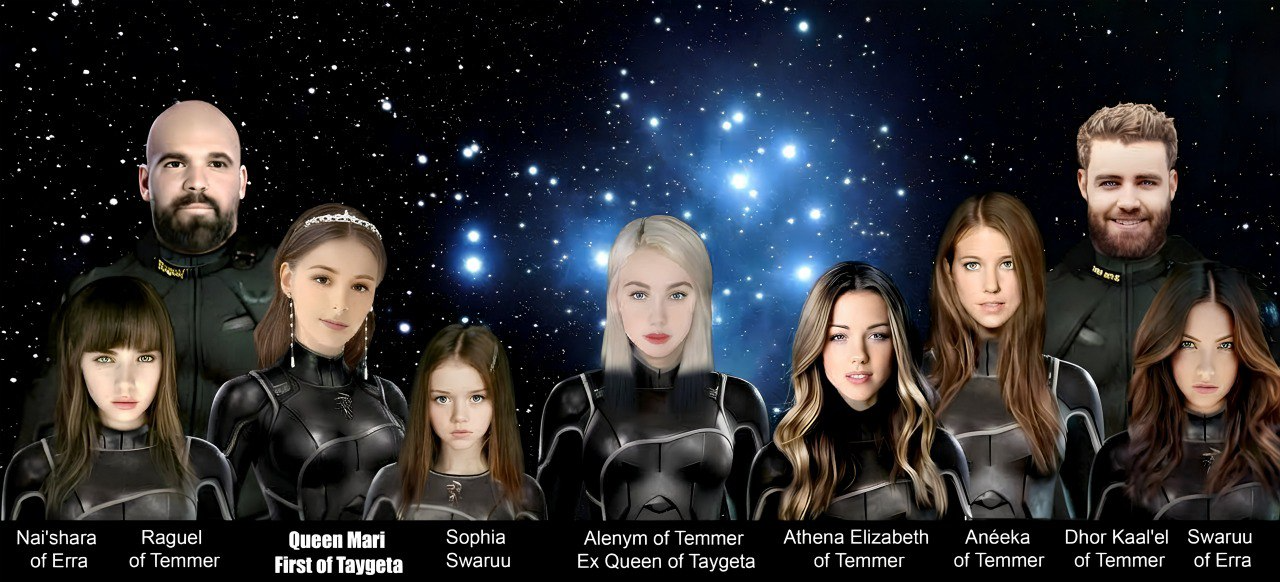
Anéeka: The curious thing is that many people here find your old planes, and even the oldest ones, very interesting. We see them as art.
Alenym: Yes, relics from all over are highly valued here. We have a small museum on board with strange things from various worlds this ship has visited.
For example, from Earth we have Egyptian figurines, which are essential, and jewelry as well. From Sumeria, we have four stone horsemen. We have samurai armor from 18th-century Japan and one from the 19th century, katana swords, European swords, Inca gold figurines, and a large feather headdress from a 19th-century Navajo chief.
Question: Are the four horsemen the Four Horsemen of the Apocalypse?
Alenym: No. They are four kings. There is no reference to them on Earth. Everything is the Four Horsemen of the Apocalypse. The closest thing is this, but these are full-figure statues, not reliefs. It represents the Babylonian civilization.
Anéeka: I find one of the samurai armors impressive. It's all red with an angry face. Because it's a full-figure armor, it looks alive with someone inside.
From other planets, there are Sassani figurines, very beautiful but extremely fragile. They're made of metal, steels and alloys not found on Earth. Polymorphous. And we have an Urmah armor. That's one of my favorite pieces. It looks like it's for the body of a gigantic cat. It's all steel-colored with red parts and a tremendous sword, about a meter and a half long, incredibly heavy. They're very extravagant in that civilization. And it has figures of tigers and lions carved on the chest.
Yazhi: They also have, in the Taygetean spacecraft, a full-size replica of the Palenque astronaut. It symbolizes being inside a flying machine. But this one isn't just life-size; it has every last detail of the original, with cracks, the grain of the stone, and everything. They have some great things. Many of them are original.
Question: What's this room like where the museum is? How are the things arranged?
Anéeka: It's one of the large, adjoining, multipurpose rooms. On other ships, these spaces accommodate living rooms or dining areas for the crew, or even storage when they have large crews. Remember, these ships are designed for a crew of 1,800, not 30 like us. They're at the back of the ship's living quarters, which ends in a living room with oval windows overlooking the otters' internal park. The rooms are equipped with humidity and temperature-regulated extractors, like the rest of the ship, except for the additional humidity extractors.
These extractors aren't in the open air; they maintain or are for the interior of the glass cases where the museum pieces are kept. And they have low lighting with individual lights for each piece to enhance the impact. It's a room, mostly dark metallic gray, with a smooth, glossy floor contrasting with the more common matte, non-slip flooring in the ship. The pieces are displayed in sealed glass cases, with few exceptions. These are mostly sculptures that are apparently sturdy.
About a year ago, an ornamental tile with a painting on it fell from the wall. The hanging wire broke, and it fell onto some ancient Sassani sculptures about a meter tall. It depicted a Sassani couple embracing, and it shattered. It was a painful loss. That's why we prefer display cases that aren't actually made of glass — I don't have a better term for it. It's a material like transparent aluminum. It was a unique piece.
Question: How big is that room?
Anéeka: There are four interconnected rooms, each approximately ten meters by six meters.
Question: And how are the paintings hung? Nailed to the wall?
Anéeka: On the walls, at every meter of height in many of the rooms, there's a rail separating each metal module that makes up the wall. A hook can be attached to this rail, and that's where things are hung.
Question: You mentioned that the museum showcases places this spacecraft has been, besides Earth. What other planets has it been to?
Anéeka: Not everywhere, but many. Among the items in the museum, besides terrestrial objects, which are the most prominent because this is where it has spent the most time, there are:
- Cyndriel artifacts: ornamental vessels.
- Art and sculpture, clothing from Alpha Centauri.
- Ancient paintings and technological artifacts from past ages of Antaria.
- Embroidered fabrics and sculptures made entirely of embroidered fabric, highly elaborate, such as three-dimensional mandalas from Pitoya of Arcturian Dieslentiplex, Korendian, and also Devonian manufacture.
- Jewelry and tunics on mannequins, all Andromedan.
- Draco armor, clothing, and jewelry.
- Ancient Urmah combat armor.
- Urmah, Engan, and Draco ceremonial weaponry, in addition to human weaponry.
- Ceremonial plates and vessels in pure, wrought gold with battle engravings of ancient Urmah manufacture.
- A collection of Sassani figurines.
- Ancient devices for controlling ships of Zeta manufacture, Gardener Greys.
- A very large collection of ancient and modern Earth art.
Question: Wow! How interesting! I was surprised you had things on the Draco.
Anéeka: Yes. Mostly weaponry and a few other things. But it's nothing compared to the museums on the Viera. Just the storage areas of the Viera museums are mind-blowing. I found a German women's bicycle from pre-war 1938 there, which I've already restored. To the best of our knowledge, the pieces are original.
Question: And do you visit the museum often?
Anéeka: No. Or only sometimes. In passing. I never tire of looking, but sometimes I just take it for granted that it´s there.
Question: Do you usually bring the objects onto the ship after being on Earth, or do you retrieve them with the tractor beam?
Anéeka: Both. The same when visiting a place. For example, the Urmah tend to give away souvenirs, while the Andromedans don't. But if you ask them and they don't use it, there's a good chance they'll give it to you. Andromedans do tend to hoard things.
Question: Who started this idea or initiative of collecting souvenirs from visited places, or is it common among races?
Anéeka: It's quite common among crews, especially on large ships. The thing is, since there are few of us on a large ship, we have space to create special places like piano rooms with a view, museums, or bike paths.
Community translations
Read in another language
These translations are contributed by community members and shown with their attribution.
This transcript does not have any community-provided translations yet.